Search

Showing posts with label Bomber Aircraft. Show all posts

TU-128 Fiddler Bomber Interceptor Aircraft

TU-128 Fiddler Bomber Interceptor AircraftThe Soviet Union had a continued and illustrious history architecture large, anarchistic aircraft, both bombers and fighters. The amazing Tu-128 was addition archetype in that continued band of designs. The Tu-128 was developed in the backward 1950s with the primarily mission of countering the perceived blackmail of America’s new abundant bomber, the massive B-52 as able-bodied as the US Navy’s A-5 Vigilante and the proposed US Air Force’s B-70 supersonic abundant bomber.

The Tu-128 Heavy Interceptor design was anon afflicted by the bootless Tu-98 Backfin adviser project. Due to the specific attributes of the 128, NATO codenamed Fiddler, mission profile; the interception of America’s adviser agile afore it could ability Soviet airspace, the aircraft bare to be huge in adjustment to backpack the massive R-4 continued range, air-to-air missiles (NATO appellation AA5-Ash) that could bang an admission ambition about thirty seven afar away. The adorning appearance of the Fiddler began in the mid 1950s and ran able-bodied into the aboriginal 1960s. What emerged was absolutely a advocate aggressive aircraft.

Continue Reading of TU-128 Fiddler Bomber Interceptor Aircraft...

Tu-22 Blinder Medium-Range Bomber

Tu-22 Blinder Medium-Range Bomber
The Tupolev Tu-22 (NATO code name: Blinder) was the first supersonic bomber to enter production in the Soviet Union. Manufactured by Tupolev, the Tu-22 entered service With the Soviet military in the 1960s, and the last examples were retired during the 1990s.

Developed in the 1950's, the Tu-22 was the successor to the Tu-16 high-altitude medium bomber. Carrying a similar payload at a slightly greater range, the Tu-22 offered no real increase in capability, although it was reportedly designed for KGB controlled high altitude reconnaissance missions as well as bombing. having a high accident rate, even by Soviet standards, and poor reliability, the Tu-22 was not a success and just about 200 were built, not enough to replace the Tu-16s Which were kept in service well into the 1970s.

Continue Reading of Tu-22 Blinder Medium-Range Bomber...

Tu-95 Bear Strategic Bomber Aircraft

Tu-95 Bear Strategic Bomber Aircraft
The Tupolev Tu-95 (NATO reporting name: Bear) is a genuinely large, four-engine turboprop-powered strategic bomber and missile platform. first flown in 1952, the Tu-95 entered service With the former Soviet Union in 1956 and it is expected to serve the Russian Air Force until no less than 2040. A naval development of these bomber is designated Tu-142.

The Tu-95 BEAR was perhaps the most successful bomber produced by the Soviet aviation, enjoying long service in many different roles and configurations. It was the only bomber deployed by any country to make use of turbo-prop engines, Which provided extraordinarily long endurance at speeds only slightly less than comparable turbojet-powered heavy bombers.

The TU-95 houses a massive bomb bay at the centre of gravity of the aircraft, which is immediately aft of the wing central torsion box. The Tu-95MS Bear H is capable of carrying six KH-55 Granat (Nato designation AS-15 Kent) nuclear-armed long-range cruise missiles with a range of 3,000km. The missiles seem to be mounted on a catapult launch drum at the bomb bay.

Alternatively, the aircraft can carry 14 Kh-SD anti-ship missiles with a range of 600km or eight conventionally armed Kh-101 air launch cruise missiles, And also this have a range of as much as 3,000km. The rear gun compartment is fitted with a twin barrelled GSh-23L cannon. The entry into the rear turret is separate from the main crew entry and is through a ventral hatch.

Continue Reading of Tu-95 Bear Strategic Bomber Aircraft...

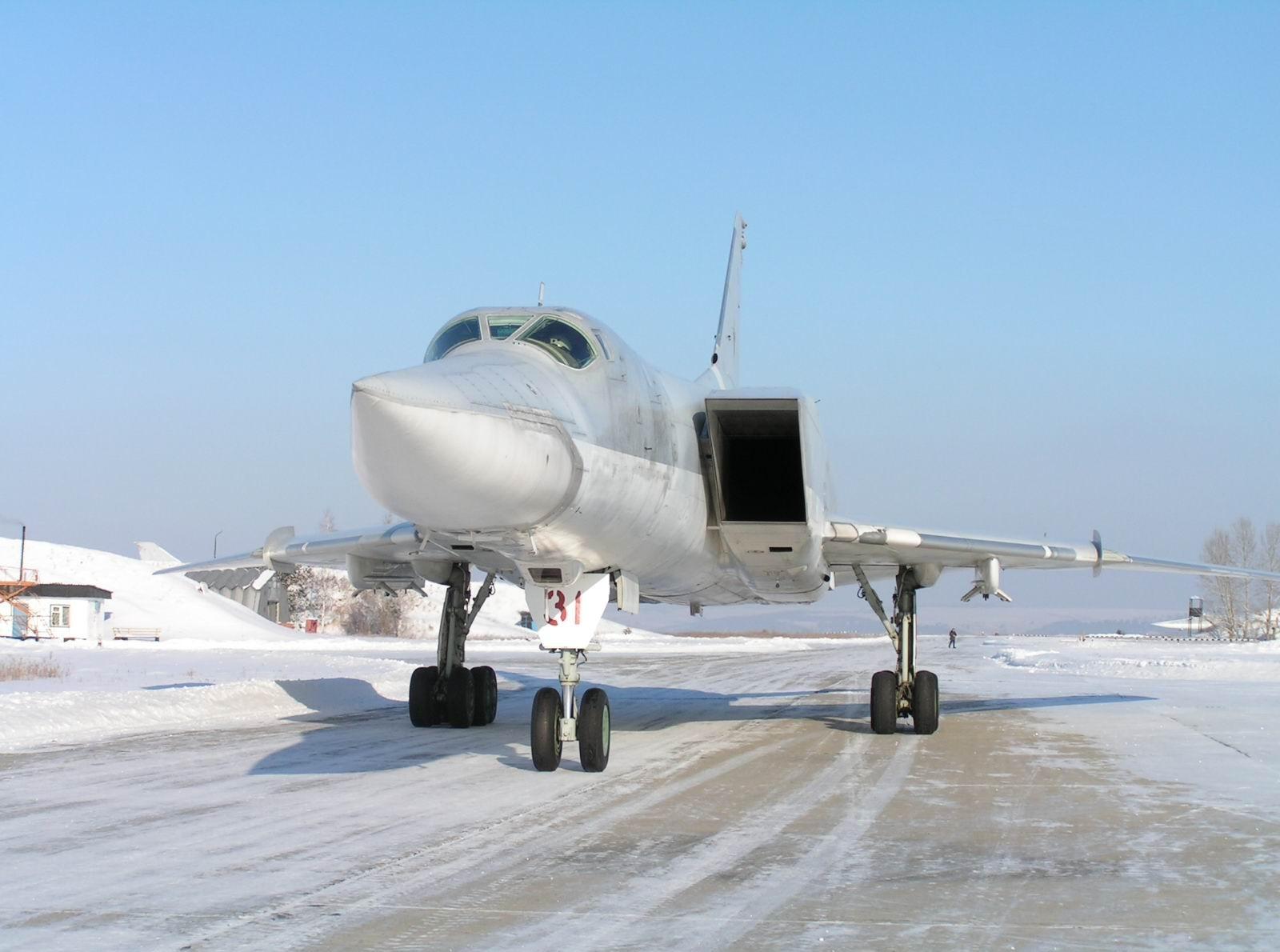
Tu-22M Backfire Long-range Bomber

Tu-22M Backfire Long-range Bomber
The BACKFIRE is a long-range aircraft capable of performing nuclear strike, conventional attack, antiship, and reconnaissance missions. Its low-level penetration features make it a much more survivable system than its predecessors. Carrying either bombs or AS-4/KITCHEN air-to-surface missiles, it is a versatile strike aircraft, believed to be intended for theater attack in Europe and Asia but also potentially capable of intercontinental missions against the United States. The BACKFIRE can be equipped with probes to permit inflight refueling, which would further increase its range and flexibility.

After designing the TU-22, the Tupolev design bureau started working on a new bomber that was based on the TU-22. Initially Tupolev considered modifying the TU-22 by changing the angle of the swept wings and equipping it with more powerful engines. However after developing the design "106" and various analysis, the design did not meet the flight characteristic requirements. Tupolev also developed the design "125". The aircraft was supposed have two VK-6 engines, a range of 4500-4800 km and an operating speed of up to 2500 km/h. The design provided for the use of titanium alloys and advanced electronic systems.

Source : www.fas.org

Continue Reading of Tu-22M Backfire Long-range Bomber...

T-60S Long-range Bomber Prototype

T-60S Long-range Bomber Prototype
The T-60S (or Su-T-60S) project was started by the Sukhoi bureau in 1984 and was speculated to enter service in 2003. it was designed to switch the Tu-22M and also the Su-24. The T-60S is a} long-range supersonic tactical/operational nuclear-capable bomber with stealth technology developed by Sukhoi. although its development was officially secret, the T-60S was reported to be in the prototype stage and ready for flight testing in mid-1996.

Very little is known concerning the technical characteristics of this aircraft, that stay classified by the Sukhoi design Bureau. The T-60S is reported to be a high-altitude, high-speed bomber. The T-60S may contains a lifting body fuselage and a swing-wing construction. the design may be capable of supercruise at Mach 2, with engines probably equipped with two-dimensional thrust vectoring nozzles to solve the matter of insufficient horizontal control at the aircraft's high speeds. The T-60S was supposed to switch the current fleet of Tu-22M supersonic bombers, though this project has most likely been aborted.

Continue Reading of T-60S Long-range Bomber Prototype...

Tu-160 Blackjack Heavy Strategic Bomber

Tu-160 Blackjack Heavy Strategic Bomber
The Tu-160 NATO reporting name: Blackjack is a heavy multi-mission strategic bomber designed for operations starting from subsonic speeds and low altitudes to speeds over Mach 1 at high altitudes. the two weapons bays will accommodate different mission-specific masses, as well as strategic cruise missiles, short-range guided missiles, nuclear and standard bombs, and mines. Its basic armament of short-range guided missiles and strategic cruise missiles allows it to deliver nuclear strikes to targets with preassigned coordinates. in the future, once the aircraft is equipped with high-precision standard weapons it may used against mobile or tactical targets.

The TU-160 can carry up to 12 Kh-55 long range missiles and Kh-15 short range missiles. The weapons bays can accommodate different loads: carries numerous bombs: From fee falling nuclear and regular up to 1500 kg bombs. The bomber isn't equipped with artillery armament.

The Tu-160 equipped with a combined navigation-and-weapon aiming system, RID; [radar] for detecting targets on the ground and sea at long range distances, an optical-electronic bombsight, an automatic terrain-following system, and active and passive radio-electronic warfare systems, as well as a probe-and-drogue airborne refueling system.

Continue Reading of Tu-160 Blackjack Heavy Strategic Bomber...